PIANO for SINGING TEACHERS · 2026

Lack of piano slowing down your singing teaching?

(Even though you really know your stuff).

Get the missing pieces in your piano expertise.

  • Even if you’re flat-out busy

  • Even if… piano’s never been your thing

  • Even if… you’ve tried before and given up

8 weeks · Made by a singing teacher


Magnificent Singer black.png


“Your piano for singers course was so amazing. I can now play fairly skilful piano from zero (or one fingered synth) and I use your skills every day. You are such a naturally great teacher too.”

—Ed Staunton (London)

Director and Vocal Coach at Soho Vocal Tuition


Violet Blue Block.png


✦ Piano: the entry card to your best teaching

That vital missing piece that helps you:

  • transform your lessons, workshops, and choirs from “nice” to life-changing

  • uncover your unique ‘flavour’ on teaching

  • establish your specialised teaching reputation 

Avoid wasting time on the things you don’t need by identifying where your piano gaps are to cross the communication gap and:

  • teach melody

  • help match pitch

  • build vocal technique

  • coach harmonies

  • interpret song charts

  • accompany song authentically

  • guide song interpretation

  • lead rehearsals, workshops and 121 sessions


Pastel blue block.png


✦ PIANO for SINGING TEACHERS · 2026

Warm-ups • accompaniment • commercial styles • lesson flow

8 weeks · Feedback included · In-lesson focus


Pastel blue block.png


✦ The piano problems of accomplished singing teachers

You can explain breath support and vowels in your sleep — but the moment you have to play, your hands turn to stone.

Backing tracks? Fine. Until they start dictating you.

Piano is a complete mystery — but you’ve not been taught you to use the piano to teach singing.

• rely too heavily on tracks
• feel awkward accompanying
• sound stiff in commercial styles
• avoid the piano — or underuse it
• feel embarrassed playing in front of students or parents
• spend ages practising one song only to teach it twice
• struggle with keys, chords or transposition
• want lessons to feel more musical and connected
• want stronger contemporary piano skills
• want to feel more confident and authoritative in the room


121 Lesson Case Study 3.png
 

I’d got so bored of learning piano in the traditional way. Couldn’t get into learning Jingle bells. This is the first thing that’s actually made me excited to use it in lessons. Love this.

—Zara (Musical Theatre Singing Teacher)

 
Peach Block.png
 

Go from:

  • Avoiding or underusing piano in lessons and workshops

  • Over relying on YouTube, backing tracks, and generic warm-ups exercise patterns

  • Lost with chords or having to spend weeks practicing up just one song only to teach it once

  • Highly concerned your students are not getting a top level and complete singing lesson

  • Feeling embarrassed playing in front of students, parents and colleagues

  • Frustrated at not being able to teach comprehensively your best through gaps in their ability to cross the communication gap.

  • Limited in your professional teaching ‘tools’

  • Feeling being considered less good than other teachers

  • Having to hire accompanists and feeling second-rate next to teachers who can play

  • Struggling to deliver the high quality 121 singing lesson, class or workshop you are capable of

To:

  • Using the piano to play simple, musical and supportive song accompaniments straight from a song sheet

  • Expertly using the piano to teach and coach

  • Play authentic pop accompaniments

  • Run flexible warm-ups

  • Break down melodies on the fl

  • Lead your classes straight from the piano with confidence — without needing hours of practice or a classical diploma.

  • And feel good about putting yourself ‘out there’ as a teacher with something in-demand to offer.

  • Having a lasting collection of piano skills aligned to your current and future career goals

  • Personalising warm-ups on the spot for 121s and workshops

  • Filming short practice videos breaking down song melody in their ‘best key’

  • Confidently showcasing your teaching in lessons, interviews, and community settings

  • Effortless key changes

Without:

  • Grinding through endless piano practice you don’t have time (or enthusiasm) for.

  • Learning nice-to-have piano techniques that ulimately don’t support your singing teaching or future career choices

£310 first 5 places / £510 remaining 5 places


Get patterns, not pieces

Singing teachers already know about melody and song story

Singing teachers don’t need more repertoire, they need reusable structure: patterns.

Patterns are:

  • the foundation of commercial-style teaching

  • the secret behind great vocal warm-ups, breaking down melody and vocal harmonies

  • the key to reading chord charts — never be scared of a chart again

  • the engine of rhythm, great phrasing and riffs

  • the doorway to beautiful accompaniment that supports the singer

  • the fastest route to flow and rehearsing large groups

Patterns train your hands so your ears can stay on your student.


✦The 3 piano skills singing teachers actually need

For this, you don’t need endless scales, years of formal study, or piles of repertoire.
You need 3 specific abilities that make teaching more connected, more musical, and far less stressfu


Play and listen

The ability to play while genuinely listening to your student — adjusting rhythm, phrasing, tuning and energy in real time.


Play with feeling (not clunk)

Clumsy piano playing is deeply annoying to the singing teacher. Your piano skill may be beginner, but you’re not a beginner to music. Heavy dynamics, clumpy chords and stop-start piano disrupts a warm up flow, It’s frustrating, not enjoyable and your students notice it too.


Learn Patterns, not pieces

You need custom piano patterns. The exact set of piano patterns for your singing teaching, vocal coaching or choir leading. Different to mine, different to your colleagues. Exact to you.

 
Magnificent Singer black.png
 

“I came to Elizabeth as a lapsed classical pianist looking to develop my keyboard skills in different areas (choral accompaniment and jazz). Elizabeth is extremely knowledgeable in a range of genres and techniques and she is fabulous teacher - warm, encouraging and learner-focused. As a teacher myself, I really appreciated her effective communication and helpful resources. Her guidance and feedback helped me to develop my confidence as a musician.”

—EIMEAR

 
Piano for Singers London Modern Jazz Vocal Styles (small).png


“Just learn piano,” they say.

“It’ll help your teaching,” they say. You would think! But in reality singing teachers need a specific kind of piano. They need piano with purpose —the kind that supports the singers, unlocks style, and saves lessons from chaos.
Which makes the ‘piano route’ not always helpful.


WNL - Powder Blue.png
 

PIANO for SINGING TEACHERS

✦The Patterns to Presence Method

The 6 foundations are key to playing connected, beautiful piano to help you teach deeper and more effectively.

✦1. Progressions

Keys, chords and where to put your hands knowing it will support your students. The foundation of fearless playing. You will move away from being worried about ‘getting it right’ —to let’s see what music we can make today! Incredibly useful for drawing out the song story and an artistic, connected performance. Never be scared of a chord chart again — no matter what gets put in front of you last minute.

✦2. Pocket

So important for singing teachers who work with musical theatre and popular styles. And even contemporary classical. From straightforward pop to the more sophisticated styles of jazz, soul, funk, latin and RnB. Even simple pop ballads have a pocket. Getting into the pocket to play is one of the main shifts for classical trained pianists.

✦3. Posture & Presence

How to avoid wreaking your singing voice. And how we lead and communicate from behind the piano. How we reassure. How we cue. Helps you become independently confident in leading large groups, workshops and choirs Making you VERY employable (and besides this is fun).

✦4. Professional Polish

Making a beautiful sound — yes, even on that school piano, or your budget keyboard. This matters hugely. Your musical ears and aesthetic is advanced you will be frustrated with clumsy playing. And your students will notice it too. Play with a professional “touch” and get to musical and simple. Much more effective than sloppy. Pointless.

✦5. Purpose

In lessons are we connecting, coaching, or are we accompanying? Lessons demand different needs and this impacts dynamics, intensity, rhythm, warm up patterns and chord voicings. With some students we play with drive - hello chatty group! -with others we need to slow down.

✦6. Positioning.

Even the most career-modest of singing teachers has a niche. And yes, it helps with marketing, attracting job offers and interesting projects. But mostly it helps you become aware and acknowledge what you are about. Clicking into yourself helps you choose the piano skills you need both now and in the coming years. Lots of time wasting avoided.


WNL - Powder Blue.png
 

@Bluthner Piano Studios

 
Charcoal.png
 

✦How it works

  • 8 weeks

  • small cohort

  • feedback included

  • practical only

  • built around real teaching situations


Screenshot 2025-09-25 at 23.26.44.png

Ivory Block.png
 

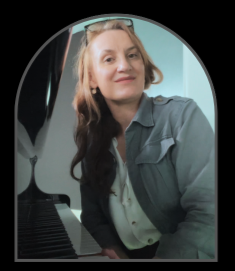
✦Piano has brought me many career advantages

And a lot of pleasure too.

In the last 12 months I’ve used piano to…

  • Teach 3-part harmony in the moment — no backing tracks.

  • Build instant rapport with shy and anxious adults.

  • Shape artistic phrasing live in the moment as they sing.

  • Lead groups with authority

  • Assess students in auditions and exams.

  • Run a private Central London studio.

  • Direct and accompany student showcases.

  • Be invited to teach on jazz summer schools & vocal residentials.

  • Prep singers across real-world styles using chord sheets:

    Bolero • Bossa Nova • Pop Ballad • Country • Funk • RnB
    Blues • Rock • Soul • Swing

    → exploring keys, tempo shifts, dynamics & groove to uncover their real voice.


And this isn’t unusual…In the past I’ve also…

  • Led departments and assessed degree-level exams.

  • Run large-group show rehearsals — solo.

  • Worked inside professional studios

  • Taught jazz vocal performance workshops — latest: Caer Llan Jazz, Wales.

  • Prepped students for auditions, live performances & masterclasses
    (Dr. Matthew Knowles attended the last one).

  • Created vocal warm-ups that unlock style, body work & creative phrasing.

  • Broken down tricky melodies — helping students find the centre of the note.

  • Taught 3–4 part harmony: A Cappella • SATB • Counterpoint.

Most of which I kind of took for granted because I’ve always played the piano (Not always spectacularly well, I might add). But it’s always been there chugging away in the background. The benefits of having piano as a singing teacher have been huge.


 Price

£310 — first 5 places
£510 — remaining places

Small cohort • personalised feedback • practical teaching focus


✦ Guarantee

Of course I want you to be overjoyed with Piano for Singing Teachers … particularly if you've struggled with piano in the past. It’s unlikely you’ll need this guarantee — the set up of the programme allows for an achieveable outcome and it should become clear if you are struggling. But if you're unhappy at the end of the 8 weeks, I'll offer you another 8-week package free. Simply demonstrate that you've practiced the challenges, sent your weekly videos and followed through on the weekly feedback videos, and you'll receive a complimentary round of another Piano for Singing Teachers.

—ELIZABETH

 
Lesson-Ready Challenge 3.png